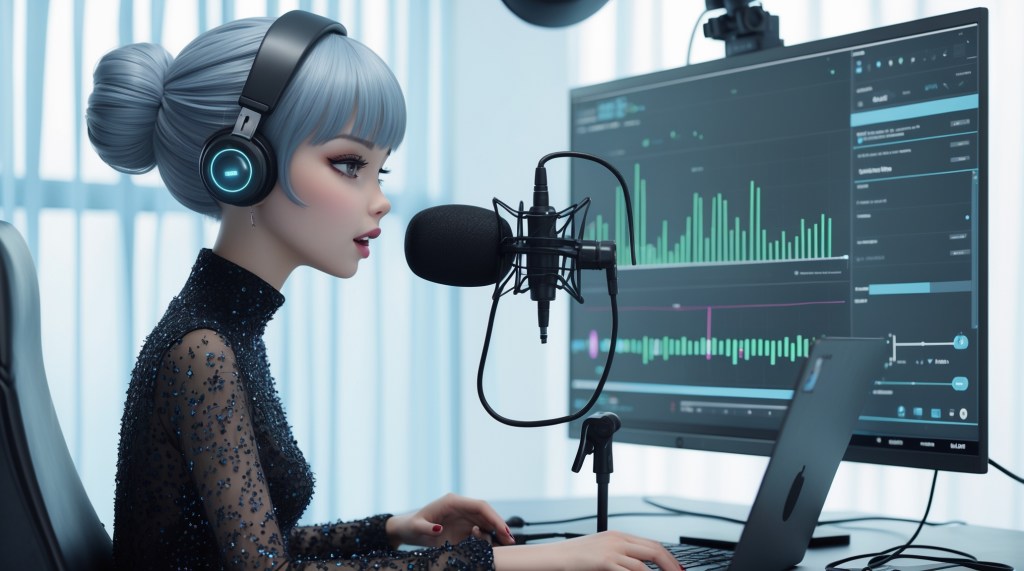
VTubers aren’t just content creators, they’re living, breathing digital personas. And nothing breathes life into a virtual avatar like real-time lip syncing.
When your mouth moves in perfect harmony with your voice, the illusion becomes reality. You’re not just playing a character—you are the character. From subtle whispers to emotional outbursts, mouth movement animation is what bridges the gap between performer and persona. But the precision is required for that illusion? That’s no accident. It’s a product of deep tech and smarter pipelines, not just fancy rigs.
In this blog, we’ll go beyond surface-level talk and dig into how real-time lip sync animation works, the tech that powers it, and why this underrated piece of VTuber technology is essential for audience immersion.
Lip Syncing: Not Just a Feature, It’s Your Avatar’s Voice
You’ve probably seen it before: a VTuber’s voice is energetic and expressive, but their mouth barely flaps open. It’s immersion-breaking. Even the most gorgeous VTuber avatar will fall flat if their facial movements don’t match their voice.
Even the most detailed VTuber model falls flat without proper lip syncing. When your voice and mouth movements don’t align, immersion breaks, and your performance suffers.
Here’s why lip sync is more than just a tech add-on:
🔊 Voice mismatch ruins immersion.
A dynamic voice with stiff lips distracts viewers and undermines your performance.
🧠 Viewers connect with expression, not code.
It’s not about the algorithm, it’s about making your avatar feel human.
💡 Lip sync is the delivery mechanism of your persona.
It’s not extra polish. It’s how your character speaks to the audience.
🎭 Great lip syncing adds emotional weight.
From comedic timing to heartfelt moments, synced animation enhances every beat.
Your real time lip sync animation is the face of your voice. Get it right, and your VTuber stops being a model, and starts being a believable digital personality.
Under the Hood: How Real-Time Lip Sync Actually Works?
So how does your VTuber model go from hearing a sound to forming perfectly synced mouth movements in milliseconds?
There are typically two core methods in real-time lip syncing today: audio-based analysis and camera-based facial tracking. The best VTuber setups often use a hybrid of both to increase accuracy and performance fidelity.
1. Audio-Based Lip Syncing (Viseme Mapping)
This is the more traditional and accessible approach, especially in tools like VTube Studio, Animaze, or Luppet.
How It Works?
Your mic picks up your voice → software breaks the audio into phonemes (the smallest units of sound) → these phonemes are mapped to visemes, which are corresponding mouth shapes in your avatar.
Think of phoneme-to-viseme mapping like a translator:
- The “O” in “hello” triggers a round-lip viseme.
- The “M” in “me” triggers closed lips.
- “F” or “V” sounds push your avatar’s lower lip up to touch the upper teeth.
The key here is speed and prediction. Real-time systems don’t wait for you to finish a sentence, they analyze waveforms and pitch dynamically, anticipating your next sound and rendering the appropriate mouth movement animation instantly.
Pros:
- Doesn’t require a webcam, making it ideal for creators who stream audio-only or prefer privacy.
- Lightweight and highly efficient, perfect for mobile VTubing, indie rigs, or budget streaming setups.
- Easy to set up with most voice software, making it beginner-friendly and broadly compatible.
- Minimal hardware demands, allowing smooth performance even on laptops or entry-level desktops.
Limitations:
- Struggles with unclear speech, like mumbling, fast talking, or speaking with heavy regional accents.
- Can appear robotic or delayed if the viseme mapping isn’t customized to your speaking style.
- Picks up background noise, which can trigger incorrect mouth shapes and break immersion.
- Lacks expressive nuance, such as natural pauses, asymmetry, or emotional subtext in real conversations.
2. Camera-Based Lip Syncing (Facial Tracking)
Now let’s talk next-gen: camera-based real time facial animation. This is where VTuber technology truly shines.
Using your webcam (or in some cases, a depth-sensing camera like an iPhone with Face ID), the software tracks facial landmarks—especially the jaw, lips, and mouth corners. It reads your actual expressions and movement patterns, then animates them onto your model in real time.
Tools like iFacialMocap, FaceMotion3D, and Live2D Cubism (when paired with facial capture) offer this higher fidelity syncing. Some VTubers even integrate ARKit-based solutions via Unity for ultra-precise rigging.
Pros:
- Far more expressive and accurate, capturing realistic mouth motion in sync with actual speech delivery.
- Detects subtle emotional cues like smirks, sighs, or mid-sentence pauses that audio-based sync misses.
- Allows for asymmetrical mouth movement, matching how people actually talk, adding personality and realism.
- Enhances viewer connection by making your avatar feel human, responsive, and emotionally present in every frame.
Limitations:
- Demands higher CPU/GPU power, which can lead to performance drops on older or low-spec systems.
- Requires consistent lighting and minimal obstructions for accurate mouth and jaw detection via webcam.
- Best results need HD or depth-sensing cameras, making mobile or budget setups harder to optimize.
- May misread expressions during rapid movements, especially with facial hair, masks, or strong shadows.
Rigging: The Foundation Behind the Movement
Let’s not overlook the silent hero here: facial rigging.
Your avatar can only do what it’s rigged to do. If your model doesn’t have blendshapes or parameters for detailed lip movements, no software in the world will make it look realistic. Think of rigging as giving your avatar a set of muscles, without them, no amount of tracking will bring it to life.
For 2D models (Live2D), this means:
- Creating well-defined parameter sliders for mouth opening, shape transitions, and angles.
- Smartly blending between phoneme shapes.
For 3D models (VRM, Blender-based avatars):
- Using blendshapes (morph targets) or bones that control specific lip movements.
- Calibrating them to respond to both audio cues and tracking data.
In both cases, the goal is clear: your avatar should respond like a human mouth does, fluidly, not like a puppet on strings.
What Pro VTubers Do Differently?
Top-performing VTubers aren’t just using default setups—they’re customizing and optimizing their pipelines for high-end performance.
Here’s what sets them apart:
Custom Viseme Maps
Instead of relying on generic phoneme-to-viseme translation, pro VTubers tweak the response for their own speech patterns and accent. This reduces mismatch and improves realism. They often create personalized viseme libraries or use scripting to make responses more nuanced and emotionally responsive.
Audio Dampening + Filters
They use noise gates, compressors, and EQs to clean up audio before it reaches the lip sync algorithm. This prevents “false triggers” from breathing, keyboard sounds, or reverb. Advanced users go further, adjusting gain staging and input levels to keep audio consistently readable for their sync tools.
Hybrid Sync Systems
Advanced setups combine audio + facial tracking to create redundancy. If the mic misses a phoneme, facial tracking compensates. If the camera glitches, the audio still drives the show. Some even time-sync the two systems to ensure fluid transitions between motion sources.
AI-Driven Lip Sync
Emerging tools like NVIDIA’s Omniverse Audio2Face or Ready Player Me’s AI-powered rigging are pushing boundaries. These systems generate AI-based lip sync by learning your vocal delivery patterns over time. Some VTubers train models on their past streams to create more accurate lip sync, especially for non-standard speech patterns or emotional cadence.
Quick Takeaways for VTubers
Lip syncing isn’t just a tech detail, it’s what makes your avatar feel real. Here’s a quick list to help you sync smarter and connect deeper with your audience.
- Lip syncing is performance-critical: poor sync breaks immersion, no matter how good your model looks.
- Use hybrid systems (audio + tracking) for best results.
- Good rigging equals good syncing—design your model with expressiveness in mind.
- Experiment with AI tools like Audio2Face if you’re exploring cutting-edge workflows.
- Keep refining: Lip sync is not a set-it-and-forget-it step—it evolves with your voice and performance style.
The Future of Lip Syncing in VTubing
The future of lip syncing in VTubing is moving toward full-body emotional immersion, powered by AI, machine learning, and biometric sensing. Soon, your avatar won’t just match your voice, it will respond to your emotional tone in real time. Subtle cues like sarcasm, hesitance, or laughter will influence not only the mouth shape but also posture, eye movement, and overall expression. Viewers will be able to tell when your VTuber persona is genuinely smiling or simply putting on a face, enhancing immersion like never before.
Beyond emotion, language-specific syncing is gaining traction, with platforms learning to handle the differences in phoneme structures across languages like Japanese and English. Meanwhile, mobile VTubing is accelerating demand for faster, lighter, battery-efficient lip sync systems that don’t compromise accuracy. As tools become more advanced and expressive, real time lip sync animation will no longer just mirror sound, it will reflect the creator’s full personality and presence.
Conclusion
In VTubing, it’s not enough to be seen, you have to be felt. And nothing bridges that gap better than seamless, expressive lip syncing. As the tech evolves, your avatar won’t just echo your words, it’ll embody your intent, emotion, and personality in real time. Whether you’re cracking jokes, whispering lore, or dropping emotional truths, your mouth movement is the final touch that sells the performance. So don’t settle for flappy lips or robotic speech. Sync up, level up, and let your audience hear and feel every word. Because in the world of VTubing, believability starts at the lips, and the future is already talking.


 VtuberLab
Leave a reply to Tina Cancel reply