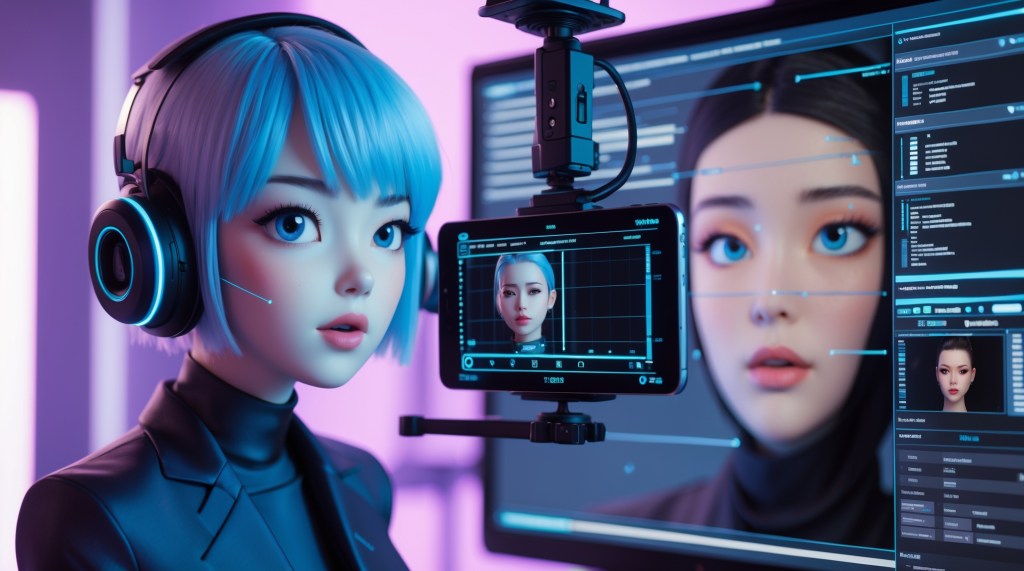
Ever wondered why some VTubers seem so alive, while others appear like stiff puppets with a fancy paint job? It’s not just about having a cool model or quirky voice, it’s about what’s happening behind the scenes, in real time, every second they’re on screen.
Face tracking is the invisible engine powering the most expressive, believable, and emotionally resonant VTuber performances, and if you’re not paying attention to it, you’re already falling behind. Face Tracking can instantly tell when an avatar’s smile feels robotic or when the eyes don’t match the mood. In a space where engagement hinges on nuance, face tracking is no longer just a “nice-to-have”; it’s your competitive edge.
Let’s break it down: how face tracking works, the tech behind it, and why, more than ever, it matters.
What Is Face Tracking in VTubing?
At its core, face tracking is the process of capturing a performer’s facial movements and translating them to a virtual character in real time. It allows the VTuber avatar to mimic expressions raising eyebrows, smiling, blinking, talking by using a combination of cameras, sensors, and software algorithms.
But unlike simple webcam filters or static masks, modern VTubing demands a far more nuanced and accurate representation of human emotion. The success of a VTuber persona depends heavily on expressive fidelity the ability of the avatar to feel “alive.” That’s where sophisticated face tracking enters the picture.
The Three Layers of Face Tracking in VTubing
Face tracking in VTubing involves a complex interplay between hardware, software, and rigging systems. Each plays a unique role:
1. Hardware: The Physical Capture Tools
Modern VTubers typically rely on one or more of the following hardware setups:
- Webcams (Logitech C920, Elgato Facecam): Suitable for entry-level 2D VTubing using software like VTube Studio or PrprLive.
- iPhone with Face ID (iPhone X and later): Leveraging Apple’s TrueDepth camera system for high-quality 3D tracking via apps like FaceMotion3D or iFacialMocap.
- Dedicated Motion Capture Systems (like Faceware or Vicon): Professional-grade setups used by high-end agencies or production studios for ultra-precise tracking.
The quality of the facial capture starts with the sensor. High frame rates (60fps+), accurate depth mapping, and infrared dot projection (used in Face ID) all contribute to smoother, more responsive animation.
2. Software: Translating Movement into Data
The second layer is software—responsible for interpreting camera input and converting it into usable animation data.
Key VTuber face tracking software includes:
- VTube Studio (2D, webcam or iPhone tracking)
- iFacialMocap (3D, integrates with Unity or Live2D)
- Animaze (successor to FaceRig, supports both 2D and 3D)
- LiveLink Face (Unreal Engine integration)
- Luppet and 3tene (popular in Japan for 3D VTubers)
These applications analyze facial landmarks, like the corners of your mouth, eyelids, brows, and cheeks and export those as real-time parameters. This data then drives the facial rig of your avatar.
3. Rigging: Making the Avatar Move Believably
Facial tracking data alone isn’t enough. Your avatar must be rigged to interpret those movements correctly.
- 2D VTubers typically use Live2D Cubism, where artists draw expressions in layers and riggers assign them to movement parameters like “mouth open” or “eyebrow raise.”
- 3D VTubers use skeletons, blend shapes, or shape keys to control facial expressions. These are common in platforms like VRoid Studio, Blender, or Unity.
Good rigging is both an art and a science. Poorly rigged models can distort expressions or break immersion. High-quality rigging, however, offers fluid, human-like animation that preserves the charm and personality of the creator.
The Role of Real-Time Animation
Real-time animation is the lifeblood of VTubing—it’s what transforms a static character into a living, reactive digital persona. Every smile, laugh, or surprised expression a VTuber makes is captured and rendered instantly, allowing for seamless interaction with live chat, gameplay events, or storytelling moments. This immediacy creates the illusion of presence, making the virtual feel human.
Here’s how the real-time animation pipeline works:
- 1. Facial Capture: A camera records the VTuber’s facial movements in real time.
- 2. Data Processing: Specialized software analyzes the movement and converts it into parameter data, such as mouth openness, brow tilt, or eye direction.
- 3. Avatar Response: These parameters drive the avatar’s facial rig, animating the virtual face instantly on screen.
This entire loop happens within milliseconds, allowing VTubers to perform as naturally as if they were on camera themselves.
However, the illusion depends on perfect synchronization.
- Lag, dropped frames, or tracking inaccuracies can immediately disrupt immersion.
- That’s why low-latency hardware, optimized software, and stable streaming setups are essential for professional VTuber performances.
How Facial Capture Works?
Let’s take a more technical look at what happens when your face is tracked:
1. Face Detection
Face detection is the first step in facial capture, where the system locates your face within the camera frame. This begins with bounding box detection, which identifies the general region of the face. Once located, landmark mapping follows, pinpointing 50 to 80 key facial points such as the eyes, nose, mouth corners, and jawline. This map acts as a foundation for all further tracking. Without accurate face detection, all subsequent animation data will be imprecise or unusable.
2. Facial Landmark Tracking
After detecting your face, the software continuously tracks specific facial landmarks that define your expressions. These include points on the eyebrows, eyes, nose, mouth, and jawline. High-quality systems use depth sensing and infrared projection, as seen in Apple’s TrueDepth camera, to capture these features in 3D. This allows the software to track subtle facial movements with precision—even in varying lighting or at different angles—making the resulting avatar animation more fluid, accurate, and emotionally expressive.
3. Parameter Mapping
Once the system has tracked facial landmarks, it converts those movements into animation parameters—numeric values that describe the position or action of each feature. Examples include mouthOpen, eyeBlinkLeft, or browDownRight. These parameters are updated in real time and sent to the avatar rig, which is programmed to respond accordingly. Parameter mapping acts as the bridge between raw motion and expressive animation, ensuring that every raised brow or smile translates accurately onto the VTuber avatar.
4. Animation Output
The final stage is rendering your facial movements on the virtual avatar. In 3D models, this is done through morph targets or blend shapes, which deform the mesh to reflect expressions. In 2D models, draw switching changes layered illustrations to match expressions. This output is processed in real time and displayed using software like OBS, VSeeFace, or Luppet. When everything works seamlessly, your avatar mirrors your live expressions convincingly, preserving immersion and enhancing audience connection.
Why Face Tracking Matters So Much in VTubing?
If your avatar can’t mirror your real emotions in real time, you’re not truly connecting with your audience. In VTubing, face tracking isn’t optional, it’s the difference between being watched and being remembered.
1. Emotional Connection
Audiences watch VTubers not just for content, but for personality. A smile that doesn’t reach the eyes or lips that move out of sync with the voice can break immersion and reduce emotional impact. Face tracking builds a bridge between avatar and audience.
2. Performance Quality
Top-tier VTubers don’t just talk—they act. They emote, react, dramatize, and entertain. Face tracking turns a livestream into a performance art, where every micro-expression adds to the narrative.
3. Brand Identity
Unique facial quirks can become part of your brand. Just like a famous actor’s expressions become iconic, a VTuber’s smile or eyebrow twitch can become part of their signature. This only works if the tracking is sharp and consistent.
4. Platform Versatility
With good tracking, your avatar can exist across YouTube, Twitch, TikTok, and even in the metaverse. Whether you’re recording videos or interacting live, real-time facial capture makes the experience seamless.
Common Pitfalls and What to Watch Out For
Even with great tools, there are challenges in using face tracking for VTubing:
- Calibration Errors: Tracking can get skewed by lighting, background, or camera angles.
- Expression Bleed: Some rigs over-respond, making every twitch overly dramatic.
- Model-Rig Mismatch: A highly expressive rig paired with basic tracking software can look uncanny or fake.
- Performance Lag: If your CPU/GPU is overburdened, tracking may delay or stutter.
To avoid these issues:
- Optimize your lighting (soft, even light on your face)
- Regularly recalibrate your tracking
- Choose models and rigs that match your facial dynamics
- Invest in good hardware if you stream professionally
The Future of Face Tracking in VTubing
VTuber technology is hurtling forward, and face-tracking is poised for a dramatic leap. First, AI-enhanced tracking will refine facial capture to near-film-quality precision, even filling in missing movements when sensors hiccup. Layered on top, emotion-recognition engines will move beyond raw muscle data, reading nuanced states like joy, irritation, or subtle sarcasm so avatars reflect true emotional depth.
Meanwhile, cross-platform standardization, seamless data hand-offs between tools such as VTube Studio, Unity, and Unreal, will let creators drag-and-drop their avatars anywhere without fragile workarounds. Finally, hands-free performance is coming: eye-tracking, full-body language detection, and neural voice synthesis will allow VTubers to act out entire scenes with almost no manual controls.
Together, these advances promise virtual performers who are not just expressive but practically indistinguishable from their human counterparts, raising the bar for every creator who wants to stay relevant.
Final Thoughts
Face tracking might sound like a cold, mechanical process, but it’s deeply human. It’s about preserving nuance, conveying personality, and creating a direct connection between creator and audience. As a VTuber, your avatar is both your mask and your amplifier. It lets you speak louder, express more, and be more “you” than ever before. And none of it works without face tracking done right.
So the next time you blink and your avatar blinks with you, or when your community laughs at your goofy, surprised face, remember that it’s not just cute animation. It’s real-time empathy made possible by code, cameras, and creativity. Welcome to the future of performance.


 VtuberLab
Leave a comment