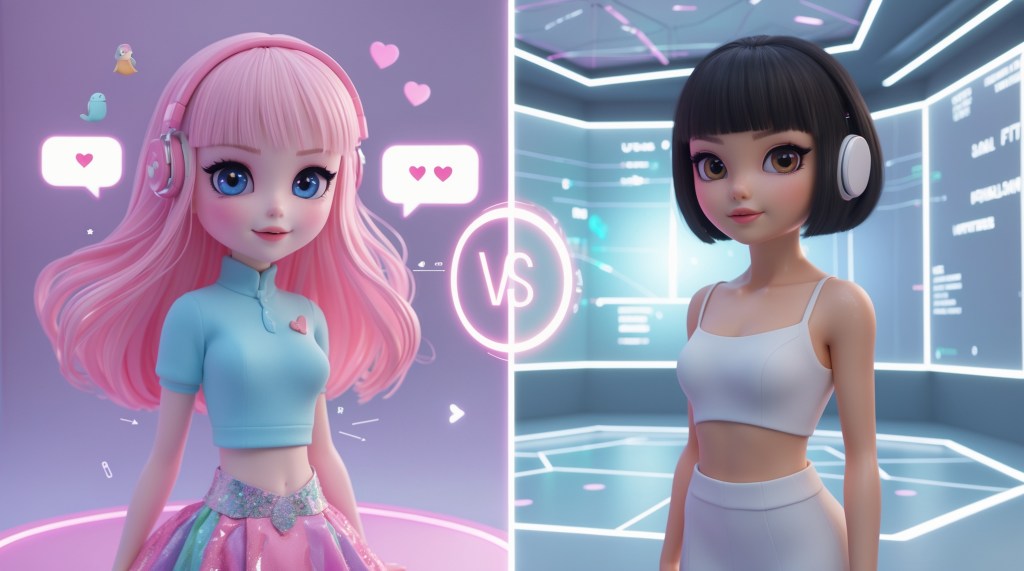
VTubing has rapidly transcended its origins as a niche subculture to become a global creative revolution. Blending animation, performance, and real-time interaction, VTubers, short for Virtual YouTubers, are at the forefront of how audiences now experience content. With virtual personas ranging from ethereal anime beings to futuristic AI avatars, this phenomenon is reshaping identity and engagement on the internet.
As the barrier to entry lowers and more creators step into the virtual spotlight, one question consistently surfaces: Should your VTuber model be 2D or 3D? While this may appear to be a purely stylistic choice, it’s far more strategic in practice. Your decision affects everything, from software and hardware requirements to audience perception, creative flexibility, production workflows, and even the tone of your community.
In this comprehensive guide, we’ll dive into the core differences between 2D and 3D VTuber models, analyzing how each format supports different content styles, technical setups, and long-term goals.
What is a VTuber Persona?
Before diving into the technical specifics, let’s establish the foundation: a VTuber persona is your digital identity. It’s a curated avatar that visually represents you, often animated in real time via motion capture and face-tracking technologies. Whether you’re a Male VTuber channeling cyberpunk aesthetics or a Female VTuber with a magical girl concept, your persona is the lens through which your audience experiences your content.
The persona is more than art, it’s voice, character, attitude, and world-building. It can be quirky or mysterious, realistic or fantasy-driven. It’s this blend of performance and digital art that has turned VTubing into a multidimensional craft.
The Rise of 2D and 3D VTubing
VTubing gained mainstream traction through 2D avatars, with pioneers like Kizuna AI popularizing Live2D-style expressions and interactions. Over time, the emergence of more powerful graphics engines and motion capture tools paved the way for 3D VTubers like Filian or CodeMiko, who perform in immersive virtual environments with full-body movement.
Both formats continue to evolve. Live2D has become more fluid and dynamic, while 3D tools are becoming more accessible and stylized. As platforms like YouTube, Twitch, and TikTok embrace VTubers, the question is no longer “what’s better?” but “what’s right for your goals?”
2D VTuber Avatars: Aesthetics, Access, and Expression
How It Works?
2D VTuber models are typically created in software like Live2D Cubism, then animated in real time using programs such as VTube Studio. These avatars consist of flat images that are rigged with multiple parameters to simulate motion—blinking, tilting, mouth movements, and more.
Advantages of 2D Avatars
- Lower Entry Barrier: Most 2D VTubers can get started with a mid-range webcam and facial tracking. No need for VR rigs or mocap suits.
- Cost-Effective: Commissioning a 2D model is generally more affordable than 3D, especially for those on a budget or experimenting with VTubing as a side project.
- Stylized Appeal: 2D models offer the unique charm of hand-drawn anime or cartoon styles. They’re ideal for creators who want a refined, polished aesthetic.
- Great for Expressive, Dialogue-Driven Content: Storytelling, commentary, and reaction content thrive with 2D models that highlight facial expressions and subtle emotions.
Limitations
- Limited Movement: While 2D models simulate head turns and blinks beautifully, they can’t interact with 3D spaces. You won’t be doing any jumping, dancing, or rotating.
- Less Immersive for Gamified or Physical Content: If your stream involves action-heavy gameplay or virtual interactions, 2D may feel static.
3D VTuber Avatars: Immersion, Motion, and Scale
How It Works?
3D VTuber models are built in environments like VRoid Studio, Blender, or Unity, and tracked using tools like VSeeFace, Luppet, or iFacialMocap. These avatars are fully three-dimensional, allowing them to move in virtual space—walk, dance, spin, interact with environments, and more.
Advantages of 3D Avatars
- Full-Body Performance: Ideal for creators who want to include body language, gestures, or physical performances (e.g., dancing, workouts, VR gaming).
- Immersive Experiences: You can create entire virtual sets, interact with objects, and even build mini-games within your stream.
- Greater Versatility: From hosting a podcast in a digital studio to performing concerts on a virtual stage, the scale of content possibilities is vast.
- VR Compatibility: Want to join a VRChat meet-up or perform in a virtual theater? 3D models are the gateway.
Limitations
- Higher Cost: Creating and rigging a high-quality 3D avatar, along with purchasing motion capture devices or VR headsets, is a considerable investment.
- Steeper Learning Curve: Tools like Blender or Unity require technical proficiency. Even with beginner-friendly options like VRoid, customizations take time.
- Rendering and Performance Requirements: Streaming 3D content in real-time is CPU/GPU intensive. Expect to upgrade your system.
Male VTubers vs. Female VTubers: Do Style Preferences Differ?
Traditionally, Male VTubers and Female VTubers have gravitated toward different stylistic choices, but the landscape is shifting. Female VTubers initially embraced the expressive charm of 2D avatars, often drawing from anime-inspired designs to convey emotions with precision and style. In contrast, many Male VTubers leaned toward 3D models that allowed for more physical presence, especially in action-oriented or VR-based content.
However, this gender-based divide is rapidly dissolving. Today, creators across the gender spectrum are embracing both 2D and 3D styles, based on artistic direction, not outdated norms. A Male VTuber can confidently adopt a 2D fairy-tale character with sparkles and wings. Likewise, a Female VTuber can fully own a powerful 3D cybernetic warrior persona, complete with dynamic movement and virtual world interaction.
This evolution reflects a broader cultural shift: VTubing now prioritizes persona authenticity and creative freedom over traditional gender expression.
Key Considerations Influencing Style:
- Content Focus: Is the channel built around performance, conversation, or storytelling?
- Audience Demographics: What aesthetic do your viewers resonate with?
- Technical Setup: What hardware and software can you consistently operate?
- Personal Comfort: Which format allows you to best express your VTuber persona?
In short, style preferences no longer depend on gender, they reflect identity, intent, and creativity. As the VTubing space matures, the most successful creators break molds rather than fit into them.
Software and Tools Breakdown
Choosing between 2D and 3D VTubing doesn’t just involve aesthetics, it also depends heavily on the tools you use. Each format requires its own ecosystem of software for model creation, rigging, and real-time streaming. Here’s a breakdown of the most commonly used VTuber software options:
2D Tools
- Live2D Cubism: This is the gold standard for rigging 2D VTuber models. Artists import layered PSD files and animate them with physics-based motion. It supports expressive face movement, blinking, mouth sync, and body sway—bringing static illustrations to life with surprising realism.
- VTube Studio: Often paired with Live2D models, VTube Studio uses a webcam or iPhone for facial tracking. It’s user-friendly, with a clean interface and support for hotkeys, background changes, and customizable parameters, ideal for beginners and pros alike.
- PrprLive / Animaze: These alternatives offer similar face-tracking capabilities. PrprLive supports Leap Motion hand tracking and GPU-based enhancements. Animaze (from the makers of FaceRig) features an avatar library, filters, and easy Twitch/YouTube integration.
3D Tools
- VRoid Studio: Designed for accessibility, VRoid Studio lets users build 3D anime-style avatars with no prior modeling experience. It includes sliders for facial features, hair customization, and clothing design.
- Blender: A powerful, open-source 3D suite used for creating fully custom avatars. While it has a steep learning curve, it offers unmatched flexibility for professionals who want to build models from scratch.
- VSeeFace: A real-time face and hand tracking application that supports VRM models. It’s compatible with Leap Motion and iPhone tracking and is widely used for high-quality 3D streaming.
- Unity + VMagicMirror / Luppet: These are advanced tools used for full-body tracking and motion capture setups. VMagicMirror enables desktop-only streaming with keyboard tracking, while Luppet supports complex VR setups for immersive live performances.
Together, these tools form the backbone of the VTubing ecosystem, enabling creators to express their personas in increasingly dynamic and professional ways.
Choosing Based on Content Type
When deciding between a 2D or 3D VTuber model, one of the most critical factors is your content type. Your format should enhance your performance, not limit it. For creators focused on chatting, commentary, or reaction-based streams, 2D avatars are typically ideal. They emphasize facial expressions and subtle gestures, helping maintain intimacy and personality without the technical demands of 3D. Similarly, for non-VR gaming content, both 2D and light 3D avatars work well, depending on the visual tone you want to set.
However, if your content revolves around VR spaces, such as VRChat interactions or virtual exploration, 3D is essential. It allows full spatial movement and immersion, making your avatar feel grounded in the virtual world. Music performances and dance-based streams also benefit from the dynamic motion of 3D avatars, enabling full-body animation and audience engagement. On the other hand, storytelling and art-focused VTubers often prefer 2D for its stylized aesthetic and focus on expression.
For a quick reference:
- Chatting / Commentary – 2D
- Gaming (non-VR) – 2D or Light 3D
- VR Content / VRChat – 3D
- Music / Performance – 3D
- Art / Storytelling – 2D
- Interactive Skits / Roleplay – 3D
Ultimately, let your content guide your format—your model should serve your creative goals, not the other way around.
Looking Ahead: The Hybrid Future of VTubing
The next wave of VTubers may not be confined to 2D or 3D. With tools like ReadyPlayerMe, AI animation assistants, and mixed-reality broadcasting, hybrid avatars are becoming more common. Expect to see avatars that transition between formats depending on context—2D for casual streams, 3D for concerts or special collabs.
As the VTubing space grows, creators will experiment more boldly with their personas, blending animation, storytelling, and interaction into richer digital expressions. Whether you begin in 2D or leap into 3D, adaptability will be a defining trait.
Final Thoughts
The question of “2D or 3D?” is not about which is superior; it’s about which is right for you. Consider your resources, technical skills, aesthetic goals, and the kind of relationship you want with your audience. Ultimately, VTubing is a creative playground. Whether you’re a Male VTuber, Female VTuber, or completely non-binary in your approach, your digital form should amplify your voice, not constrain it. The stage is virtual, but your impact is real. So craft boldly, choose wisely, and let your VTuber persona shine in whichever dimension you call home.


 VtuberLab
Leave a comment